Disambiguates confusable skills
Near-duplicate skills are resolved once when they're added, not guessed at on every query. It's the specific failure mode Anthropic's own engineering team names as one of the most common they see.
Two skills that look alike to a text-similarity search can do very different things, and an agent that grabs the wrong one produces broken code or burns an expensive retry. Graph-of-Skills disambiguates confusable skills before your agent sees them, on top of hybrid retrieval and budget-aware selection.
Try the APIFree tier: 200 skills, 1,000 retrievals/month. No card required. Connect in under a minute.

Verbatim, from public issue trackers and forums. Each quote links to its source.
“Way more often than not, i remind the agent that the skill exists before it does anything. It's very rare that it will pick a skill unprompted.”
Graph-of-Skills matches the task to the skill with keyword and meaning-based search, instead of relying on the model to notice one line of frontmatter.
“Wrong tool selection: More tools = higher chance of picking wrong one”
Near-duplicate skills are resolved once, when you add them, so the agent is never choosing between two that look alike.
“tool definitions alone burned 50,000+ tokens before the agent touched a single user message.”
Each retrieval returns only the skills that fit your model's context limit, not the whole library.
“SkillSearch: same pattern as ToolSearch for skills. Name + one-line description at startup; full body loaded on invoke”
That is the shape of this API: one search tool your agent calls when a task starts, over MCP or as a Skill file, in any client that speaks HTTP.
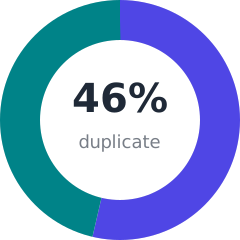
A 40,285-skill snapshot of a major public marketplace found 46.3% of listed skills share a duplicate or near-duplicate name. An agent's retrieval call already has to sort through that.
Source: Ling, Zhong & Huang, "Agent Skills: A Data-Driven Analysis of Claude Skills for Extending Large Language Model Functionality" (arXiv:2602.08004), Figure 3.
Most skill libraries rely on plain semantic similarity search, which works fine until two skills look alike. An agent doesn't fail because it has too many skills, it fails when two of them look alike and it grabs the wrong one: the file-write tool instead of the file-append tool, the templated email instead of the plain one. Independent research on agent skill selection found accuracy holds up cleanly with a small library, then drops sharply once look-alike skills are mixed in. Graph-of-Skills resolves those near-duplicates before your agent ever sees them, so a vibe-coding session reaches for the tool that actually does the job.
Near-duplicate skills are resolved once when they're added, not guessed at on every query. It's the specific failure mode Anthropic's own engineering team names as one of the most common they see.
Combines keyword search with meaning-based search, so an exact term like an error code or a function name still gets found, even though a pure meaning-based search only looks for skills that sound similar and could miss it.
Automatically picks a set of skills that fits your model's context limit, instead of handing back a fixed list and leaving you to trim it down yourself.
Your skill library is stored separately from every other customer's, the same way it already works for every other product here.
$0
1,000 retrievals/month, up to 200 skills. No card required.
$19/mo
100,000 retrievals/month included.
30-day guarantee: if Pro isn't working for you, email info@akilima.tech within 30 days and we refund your first month in full, no questions asked. Cancel any time.
Connect in under a minute: a claude mcp add command, or a Skill file for agents without MCP. See "Questions" below.
Free: 120 requests/minute. Pro: 300 requests/minute, $0.001/retrieval past the included amount.
That's the real benefit: your vibe-coding and coding sessions get the skill that actually does the job, not a near-miss that produces broken code. Skip skill retrieval entirely and your agent never gets reuse at all. Build it yourself without dedicated tuning and it lands on the same plain similarity search that fails once skills start looking alike.
It also happens to be fast and cheap: under a minute to connect, and less than the engineering time a real disambiguation build costs.
We also keep a public catalog of skills harvested from skills.sh,
each listed with its install count. Browse it on the site, or pull
the same catalog through the MCP server's
retrieve_skill_bundle tool.
A skill is a small package of instructions, scripts, and reference material an agent loads only when a task calls for it: how to use a specific API, format a document, follow your team's own process. Write it once, and your agent stops needing the same explanation in every prompt. Graph-of-Skills doesn't replace skills. It's what finds the right one once your library has enough of them that two start looking alike.
Capability Pages compares each new skill against your existing library when you add it, and resolves any that look alike, such as a file-write tool and a file-append tool. That resolution happens once, at index time, not on every query, so your agent's retrieval call never has to guess between confusable skills.
Charging more as your skill library grows would reward the exact problem this product exists to fix: large, uncurated libraries hurt an agent's accuracy, not skill count on its own. The free tier includes 200 skills and 1,000 retrievals a month, no card required. The paid tier is $19/mo (USD) for 100,000 retrievals a month, and scales with how often you call the retrieve endpoint, not with the size of your library.
The retrieve endpoint returns an error asking you to upgrade once you pass 1,000 retrievals in a calendar month, and the count resets at the start of the next month. Upgrading to the $19/mo (USD) tier raises the limit to 100,000 retrievals a month. Indexing new skills checks a separate, unrelated cap on library size, so adding skills never counts against your retrieval limit.
Every Pro subscription starts with a 30-day guarantee. Email info@akilima.tech within 30 days of subscribing and we refund your first month in full, no questions asked. After that, cancel any time from the billing portal in your dashboard and you won't be charged again.
A plain vector-search tool ranks skills purely by how similar their text embeddings look, which is exactly what breaks when two skills are near-duplicates. Graph-of-Skills adds keyword search on top of that similarity search, so an exact term like an error code or function name still gets found, resolves confusable skills before your agent ever queries, and trims the result set to fit your model's context limit instead of handing back a fixed list.
In Claude Code: claude mcp add --transport http graph-of-skills https://akilima.tech/api/graph-of-skills/mcp --header "Authorization: Bearer YOUR_API_KEY". That registers search_skills as a tool your agent can call. Any other MCP client that accepts a remote HTTP server with a custom header connects the same way. Full instructions, with your real key already filled in, are in your dashboard once you mint a key.
Install it as a Skill instead: a small file at .claude/skills/graph-of-skills-lookup/SKILL.md that tells your agent to call POST https://akilima.tech/api/graph-of-skills/retrieve with curl when a task might already be covered by an indexed skill. Skills are the same format your own library is already in: a name and a short description your agent scans upfront, with the full content loaded only when a task matches. Your dashboard has the exact file to save, with your key filled in.
No. Claude Code connects over MCP with one command. Claude Desktop, Cursor, and any other client that speaks MCP connect the same way, pointed at the same URL with your API key. If your agent doesn't speak MCP at all, or runs on a different model entirely (OpenAI, an open-weight model, one you built yourself), it can call the same retrieve endpoint directly over plain HTTP: send your query, get back ranked skills. Nothing here is tied to one vendor or one model.
Built with Wiggum, a self-driving agent loop that turns specs into verified, tested code.
Free tier: 200 skills, 1,000 retrievals/month. No card required. Connect in under a minute.